



Last summer's pants suddenly fit differently. Nothing dramatic – just two or three centimeters, maybe a button that’s a little snug. Her diet has barely changed, her walks are the same, and yet something in the middle of her body is shifting. Many women between 42 and 55 describe this moment as the first subtle signal: their body is working differently than it did ten years prior. Diets that reliably shed a few pounds in three weeks before now suddenly fall flat. The mystery behind this isn't a failure of willpower. It's a background restructuring that requires time, patience, and a completely different approach.
What really changes in your metabolism after 40
In the years around menopause, the hormonal balance between estrogen, progesterone, and insulin shifts. Estrogen doesn't drop abruptly but in waves – sometimes higher, sometimes lower, over many years. Progesterone usually falls earlier and more sharply. This up and down changes how the body stores fat, how muscle mass is maintained, and how sensitive cells are to insulin. Visceral fat – the fat around the internal organs – grows faster, while muscle mass naturally decreases from about age 40. Muscles are the body's most important energy consumer. Less muscle means a lower basal metabolic rate, even if the weight on the scale remains constant.
Added to this is insulin sensitivity, which decreases with age. Carbohydrates that the body processed without problems at 30 are more likely to end up as fat deposits in the abdominal area from 45 onwards. Cortisol – the stress hormone – often remains elevated due to sleep problems, hot flashes, and the typical life phase juggling career, children, and aging parents. High cortisol levels, in turn, block fat breakdown and intensify cravings. In Munich, Vienna, or Zurich, the same woman sits in her family doctor's waiting room and hears the same story: thyroid normal, blood values good, and yet her belly continues to grow.
Menopausal metabolism in a nutshell: Hormones fluctuate, muscle mass decreases, insulin works slower, cortisol remains elevated longer – and classic calorie rules from your thirties lose their simple correlation.
Why classic diets fail during this phase
Most diets that have been considered reliable for decades were tested on younger, hormonally stable bodies. They operate on a simple principle: eat less, move more, lose weight faster. During menopause, this principle breaks down. The reason isn't a lack of discipline, but biology.
Strict calorie reduction sends a hunger signal to the body during this phase. Cortisol rises, the thyroid gland slows down activity, and muscle is broken down faster than fat. After two weeks of dieting, the scale might show three kilos less – but the basal metabolic rate has decreased, the craving for sweets has doubled, and after six weeks, the kilos are back, accompanied by an additional bonus. Low-carb approaches that work like clockwork for younger women often lead to sleep disturbances during menopause because progesterone and carbohydrates stabilize deep sleep. Shakes and juice cleanses stress the liver, which already has to work harder during this phase of life to break down hormone residues.
There's also a psychological factor that is rarely spoken about: A woman at 48 has different priorities than at 28. The body is no longer supposed to fit an ideal image, but to carry her through – through workdays, through restless nights, through worry about aging parents in Berlin, Salzburg, or Basel. Radical diets cost energy that is needed elsewhere. What works after 40 is quieter, slower, more reliable.
The new approach: Supporting metabolism instead of starving
Losing weight during menopause isn't about deprivation, but about support. Four pillars have repeatedly proven effective in studies and in classical Ayurvedic experiential medicine:
- Maintain muscle mass. Two to three strength training sessions per week are more important after 40 than any diet. A 2023 study by the German Sport University Cologne showed that women between 45 and 55 who regularly engage in resistance training had an average of two kilograms less body fat after one year – without counting calories.
- Protein in every meal. 1.2 to 1.6 grams per kilogram of body weight daily. Protein provides longer satiety, protects against muscle breakdown, and increases the basal metabolic rate through its thermogenic effect.
- Sleep as a metabolic engine. Less than six hours of sleep per night doubles the risk of weight gain during menopause. Those who sleep through the night re-regulate cortisol, ghrelin, and leptin back towards balance.
- Actively support hormonal balance. This is where the classical Ayurvedic approach comes in – with bitter herbs, adaptogenic plants, and a gentle activation of metabolism.
In Ayurvedic tradition, the phase between 40 and 55 is considered the Vata-Pitta transition. The body becomes lighter, drier, more unstable in its rhythm. Plants like Shatavari, fenugreek, and bitter melon have held a firm place in this tradition for centuries. It is precisely along these lines that vedi meno works – a blend that supports hormonal balance, metabolism, and energy levels during this phase of life without interfering with the body.
Nutrition that truly supports during menopause
Anyone over 45 who wants to lose weight loses more on their plate than they gain on the scale. The focus shifts away from calorie counting to meal quality. Three points stand out from all nutritional recommendations of recent years:
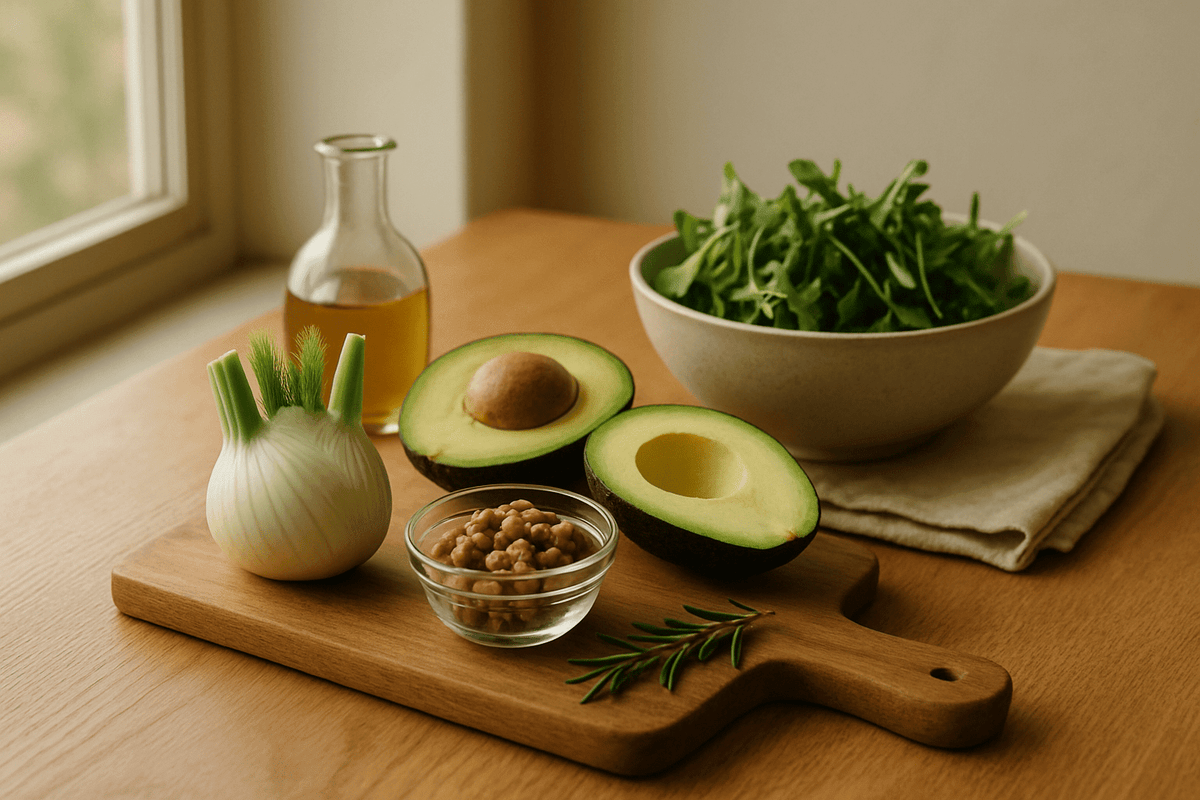
Fiber from vegetables and legumes. They feed gut bacteria, stabilize blood sugar, and help the liver eliminate hormone residues. Fennel, artichoke, chicory, and arugula are traditional companions after 40 not only in Mediterranean but also in Alpine cuisine.
Good fats instead of fat-free products. Olive oil, flaxseed oil, walnuts, avocado – these fats are building blocks for hormones. Those who cut fat during menopause deprive the body of exactly the substances it needs for hormonal stabilization.
Warm breakfasts instead of muesli from the refrigerated section. In Ayurvedic daily life, the day begins with warm water, some ginger, perhaps a small portion of oatmeal with cinnamon and almonds. The digestion-sluggish morning after 45 benefits significantly more from this than from cold yogurt with berries. Even in Hamburg, Innsbruck, or Geneva, the trend is shifting back to warm, calming breakfasts – for good reason.

Exercise that suits today's body
The topic of exercise during menopause is perhaps the most misunderstood. Many women increase their cardio regimen – more running, more spinning, more endurance. The effect is often disheartening. Too much endurance increases cortisol, and cortisol sabotages the very belly fat that is supposed to disappear.
What works: Strength training two to three times a week, supplemented by moderate walks, yoga, or Pilates. Strength training builds muscle, muscle protects the basal metabolic rate, and the basal metabolic rate makes weight loss possible in the first place. In addition, there is the often underestimated effect on bone density, which slowly decreases after 45. Those who start resistance training today protect themselves from osteoporosis in twenty years.
Here too, a shift in perspective is worthwhile: Exercise during menopause is less about burning calories and more about self-care. Twenty minutes of dumbbells in the kitchen three times a week is more effective than an hour of sweating in the gym once a week.

How Ayurveda views the hormonal transition phase
The Ayurvedic view of menopause is gentle. It knows no pathology, no deficiency, no deficit phase. Instead, it describes a transition – from the creating, childbearing phase to the wise, gathering one. The body loses the task of maintaining a cycle and reorganizes itself. The classic text Ashtanga Hridayam dedicates entire chapters to this phase and recommends a combination of warm foods, regular oil (internal and external), good sleep times, and specific plants.
Shatavari – "wild asparagus" in English – has been considered the queen of women's plants in India for two thousand years. Western studies have in recent years begun to investigate its role in hormonal fluctuations. Fenugreek supports insulin sensitivity, bitter melon has a mild effect on blood sugar, and cinnamon regulates glucose metabolism. In a blend tailored to daily life after 45, these building blocks complement each other to form a calm, supportive foundation. Anyone who understands weight loss during menopause not as a struggle but as a reordering thus aligns with both the tone of Ayurvedic tradition and modern research.
A realistic picture: what's possible in 12 weeks
What really works after 45 takes longer than the old 10-day cures. Twelve weeks is a reasonable timeframe. During this time, a woman between 47 and 53 can lose an average of three to five kilos with consistent, gentle adjustments – measured not by the scale alone, but by waist circumference, sleep quality, and afternoon energy. Quick results belong to youth; reliable ones belong to the second half of life.
Women who follow this path report less about dramatic weight loss than about a different experience: Their body feels like their own again. Last summer's pants don't necessarily fit smaller, but they fit properly again – and what has changed is no longer threatening, but ordered.
FAQ
Why do I gain weight during menopause even though I eat less?
The basal metabolic rate decreases due to muscle loss, insulin sensitivity declines, and cortisol remains elevated for longer. The same calorie intake that maintained weight at 35 often leads to gradual weight gain at 48 – especially around the abdomen.
Can I still lose weight during menopause?
Yes. Just not with the old methods. Strength training, protein, good sleep, and hormonal support are more reliable than calorie restriction. Three to five kilos in twelve weeks is a realistic goal.
What is the best diet during menopause?
A diet rich in vegetables, sufficient protein, good fats, and few processed carbohydrates. Warm, cooked meals ease digestion, which becomes more sensitive during this phase.
Does intermittent fasting help during menopause?
For some women, yes, for others, no. Shorter fasting windows (12 to 14 hours) are usually well tolerated, while longer windows (16 hours and more) can negatively affect cortisol and sleep – especially if hot flashes or nocturnal awakenings are already present.
How long does it take for metabolism to re-regulate?
With strength training, good sleep, and sufficient protein, noticeable changes usually occur after 8 to 12 weeks. Hormonal stabilization takes longer – six months to two years, depending on the starting point and support.
The time of quick answers is behind us. What remains is the opportunity to read one's own body differently – not as a project, but as a companion.